Cranial Nerve Injuries
Cranial nerves may be injured through blunt trauma and fractures. Cranial nerves XI and XII may also be injured as a result of severe hyperextension injuries to the neck.
Cranial nerves are often difficult to diagnose and indeed may easily be missed because they are often associated with other head injury that may take precedence over the cranial nerve trauma.
Cranial Nerve I (Olfactory)
Injury to the olfactory nerve fibertract may result in loss of sense of smell.
Cranial II (Optic)
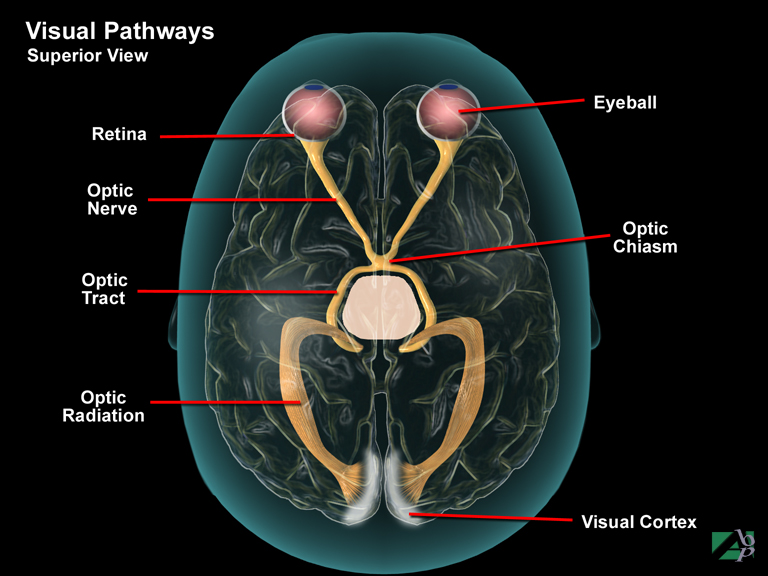
Although a rare injury, the optic nerve may be injured anywhere along its pathway, which is referred to as the optic pathway. The optic pathway includes the optic chiasm, optic tract and visual cortex.
The optic chiasm is an area near the hypothalamus near the brain where each of the two optic nerves cross over to the opposite side forming an "X". The optical pathway is the communication between the optic nerves to the optic chiasma, to the optic tract to the visual cortex. The visual cortex is located in the occipital lobe of the brain, which interprets shape, color, movement and spatial organization.
Injuries involving the optic chiasm, optic pathway or visual cortex are likely to result in loss of vision, the extent of which will depend on where the lesion occurs. Visual loss could be partial bilateral, partial unilateral, total bilateral blindness to total blindness. Injuries to these visual structures are uncommon injuries and when encountered will likely be seen with other severe head injuries and brain damage.
Cranial III (Oculomotor)
Injury to the oculomotor nerve impairs eyeball movements, may cause drooping of the upper eyelid and result in a dilated pupil.
Cranial IV (Trochlear)
Injury to the trochlear nerve may result in impairment of eyeball movement, particularly downward movement of the eye.
Cranial V (Trigeminal)
Depending on the branch involved, injury to the trigeminal branch may result in loss of facial sensation and impaired chewing.
Cranial VI (Abducens)
Injury to the abducens nerve may result in inability to turn the eyeball laterally and medially.
Cranial VII (Facial)
Injury to the facial nerve may result in paralysis of facial muscles on the side of the face affected and/or loss of taste. Bell's palsy is an example of a disorder of the facial nerve.
Cranial VIII (Auditory)
Injury to the cochlear division may result in perception deafness. Injury to the vestibular division causes dizziness and inability to maintain balance.
Cranial IX (Glossopharyngeal)
Damage to the glossopharyngeal nerve may result in the loss of perception to bitter and sour tastes and swallowing impairment.
Cranial X (Vagus)
Damage to the vagus nerve can have catastrophic results. If both vagus nerves are damaged, death follows rapidly through respiratory failure. If one nerve is damaged vocal impairment, swallowing difficulties and other visceral disturbances occur.
Cranial XI (Accessory)
Damage to the accessory nerve impairs the ability to move the head and shrug the shoulders.
Cranial XII (Hypoglossal)
Injury to the hypoglossal nerve produces impairment for speaking, swallowing and protruding the tongue.