The Brain & Skull Fractures¶
Blow-out Fracture of the Orbit
Brain/Head Injury/Complication Code Classifications
Complication Codes/Description
Mild Brain Injury Codes/Description
Moderate Brain Injury Codes/Description
Severe Brain Injury/Description
Types of Brain or Head Injuries in the system
Blow-out Fracture of the Orbit¶
· The cause is sudden, direct, blunt trauma in the form of a blow to the orbit with increase intra-orbital pressure
· The orbital rim is relatively strong so force is transmitted to the weakest parts of the orbit which 'blow-out'
o Orbital floor which is the superior boundary of the maxillary sinus or
o Medial wall (the thin lamina papyracea) which is the lateral boundary of the ethmoid sinus
· The nasal bone is also frequently fractured
· The cause is usually a large object such as baseball, fist, automobile accident, tennis ball or kick in the nose
The Orbit is composed of seven (7) cranial and facial bones:
· Superior orbital ridge and upper medial orbital ridge are part of the frontal bone
· Lateral orbital rim is part of the zygoma
· Inferior and lower medial rims are part of the maxilla. Floor of the orbit is made of the upper border of the maxillary sinus
· Medial rim separating orbit from nares is the lacrimal bone
· Medial wall and part of the posterior wall of the orbit are formed by the ethmoid bone
· Most of the posterior of the orbit is formed by the 2 wings of the sphenoid bone
· Palatine bone is posterior to the maxilla and helps form the nasal cavity and orbit
Brain/Head Injury/Complication Code Classifications¶
800 Fracture of the skull, vault
801 Fracture of the skull, base
803 Fracture of the skull, other
850 Concussion (change in consciousness)
851 Cerebral laceration (tear) or contusion (bruise)
852 Subarachnoid, subdural, extramural hemorrhage (bleed) [Complication]
853 Brain hemorrhage, other [Complication]
854 Intracranial Injury (traumatic brain injury, physical damage to brain)
Each of these codes can be further classified as open or closed fracture, with or without intracranial injury, with or without loss of consciousness, with or without concussion, with or without hemorrhage.
Codes beginning: 800, 801, 803, 851, 852, or 853 should only be used when the adjuster knows specifically that the claimant had a skull fracture or a brain hemorrhage (bleed), laceration (tear) or contusion (bruise).
For any brain injury , the adjuster can search codes 850 concussion or 854 intracranial injuries (TBI). This narrows down the choices considerably.
Concussion and amnesia¶
· When amnesia is associated with the concussion, in the system there is a separate medical code for the amnesia
· If either anterograde or retrograde amnesia accompanies the concussive injury it should be added as a complication
· Amnesia can be found in the system by doing a freeform search on 'amnesia' and selecting 'complication' or on the Medical Person by selecting 'Head' and selecting 'complication'
· The medical code in the system for 'temporary amnesia' is 437.7
Note: Anterograde is the inability to form new memories and retrograde is the inability to recall events that occurred prior to the onset of amnesia.
Conjunctival hemorrhage - Associated with an orbit fracture¶
· Does not require a separate entry in the system
· It is considered a symptom of an orbit fracture
Parietooccipital Contusion¶
· This generally refers to a contusion in the brain (cortex) in the region of the parietaloccipital fissure (where the bone comes together)
· In the system this is covered by using the 851.0 series of codes
· It is suggested that you confirm this diagnosis is actually referring to a brain injury as it is possible it could also refer to a simple head contusion
Post Concussive Syndrome¶
· Post concussive syndrome is a complication associated with head injury or a concussion.
· ‘Syndrome’ is a complex set of signs or symptoms that define a specific condition, post concussive syndrome includes several symptoms with the most common being headache(s). Since headaches(s) are included with the entry of post concussive syndrome it is not necessary to enter a separate code.
· To locate code via freeform search enter ‘post concussive syndrome’, select Complication as type and Search
· The root code is 310.2
Post-traumatic Headaches¶
Headaches are categorized as a Complication in the system. In order to be entered in the system the headaches must be persistent in nature, not just mentioned once at the time of the accident. Verify that the type of headache entered corresponds to the injury; otherwise it will not be considered in the CLA.
· 784.0 Posttraumatic Headache from Head Trauma
If a diagnosis is given of both post-traumatic headaches and post concussive syndrome, you only need to enter post concussive syndrome. Headaches are included with the entry of post concussive syndrome.
If post-traumatic headaches are entered along with post concussive syndrome, an Alert will display in the Preamble indicating the post-traumatic headaches will not be considered as part of the treatment.
Subarachnoid Hemorrhage¶
A subarachnoid hemorrhage occurs when there is bleeding in the subarachnoid space of the brain, which is the area between the brain and the tissue that covers the brain. A hemorrhage may also be described as extradural or subdural.
Subarachnoid hemorrhage can be caused by head trauma and is considered a complication in the system. It can be found in the system by entering in freeform search keywords 'subarachnoid hemorrhage' and selecting 'complication' as the type.
These codes have a root code of 852. The system also has a selection described as ‘Other or unspecified intracranial hemorrhage’ (root code 853) which can be used for any other hemorrhage not described as subarachnoid, extradural or subdural.
Types of Brain or Head Injuries in the system¶
-
Concussion - without cerebral contusion or hemorrhage
-
Further categorized by: Level of consciousness
i. Unspecified
ii. No LOC
iii. Brief LOC (less than 1 hour)
iv. Moderate LOC (1-24 hours)
v. Prolonged LOC (more than 24 hours) and return to pre-existing conscious level
vi. Prolonged LOC (more than 24 hours) and NO return to pre-existing conscious level
2. Brain contusion - bruising of the brain matter itself
- Terms for brain
i. Cortex - outer layer of brain
ii. Cerebrum (cerebral) - the largest and uppermost portion of the brain
iii. Cerebellum (cerebellar) - back or base of the brain, between the cerebrum and brain stem
iv. Brain Stem - the lower part of the brain, leads to the spinal cord
· Further categorized by
i. With or without open intracranial wound
ii. Level of consciousness
- Brain laceration - tearing of brain tissue
· Further categorized by
i. With or without open intracranial wound
ii. Level of consciousness
-
Other or Unspecified intracranial injury - anything that does not fall into the previous categories
-
Skull Fracture
· Vault - the arched (top) of the skull
· Base - the base on which the brain rests - includes the eye orbits and ear canals
· Further categorized by:
i. Open or closed fracture
ii. With or without intracranial injury
iii. Level of consciousness
** Loss of Consciousness (LOC) Levels**
· Unspecified
· No LOC
· Brief LOC (less than 1 hour)
· Moderate LOC (1-24 hours)
· Prolonged LOC (more than 24 hours) and return to pre-existing conscious level
· Prolonged LOC (more than 24 hours) and NO return to pre-existing conscious level
Mild Brain Injury¶
**850.0 ** Concussion, no LOC
850.1 Concussion, LOC <1 hr
850.5 Concussion, LOC unknown
Moderate Brain Injury¶
850.2 Concussion, LOC 1-24 hr
854.00 Intracranial injury, LOC unknown
854.01 Intracranial injury, no LOC
854.02 Intracranial injury, LOC < 1 hr
854.09 Intracranial injury, LOC unknown, with concussion
Severe Brain Injury¶
850.3 Concussion, LOC > 24 hr, return to normal function
854.03 Intracranial injury, LOC 1-24 hr
854.04 Intracranial injury, LOC > 24 hr, return to normal
854.05 Intracranial injury, LOC > 24 hr, no return to normal
850.4 Concussion, LOC > 24, no return to normal function
Complications¶
308.3 Post Traumatic Stress Syndrome
310.2 Post Concussive Syndrome
386 Vertigo
437.7 Amnesia
784.0 Post-traumatic Headaches
958.4 Traumatic Shock
Skull Fractures¶
· The system does not break these type fractures down by the exact bone as it does for other fractures (i.e. for a femur fracture exact place on the bone, such as head, shaft, distal)
· Skull fractures are broken down into two categories: Vault (top of skull) and Base
o Skull Vaulsuperior aspect of the cranium; the portion of the skull that overlies the brain. The skull vault is composed of:
§ Parietal Bone
§ Frontal Bone
o Skull Basportion of the skull which underlies the brain. The skull base is composed of:
§ Occipital Bone
§ Sphenoid Bone
§ Ethmoid Bone
§ Temporal Bone (Petrous & Mastoid)
· The two fracture categories are ‘Open and Closed’. Also needed for entry is:
o If there is any type of internal injury - with or without intracranial injury, hemorrhage, or cerebral laceration or contusion
o State of consciousness following the skull fracture - No LOC, Brief LOC, Moderate LOC, Prolonged LOC
· Note: The lower Frontal bone is also part of the base, and in most instances the scan/x-ray that diagnosed the fracture will be specific if it is the basal part of the frontal bone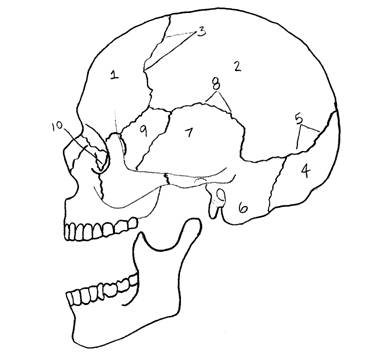
-
Frontal Bone
-
Parietal Bone
-
Coronal Structure
-
Occipital Bone
-
Lambdoid Suture
-
Mastoid Bone
-
Temporal Bone
-
Squamous Suture
-
Sphenoid Bone
-
Ethmoid Bone
Vertigo¶
In the system, 'Vertigo' is classified as a complication and there are five (5) different codes used to cover some of the most common types of 'Vertigo'. There are a variety of injuries that can cause vertigo, but some of the most common are
· Inner ear trauma/damage
· Head Injuries
· Whiplash
To determine the code that best fits the case, we recommend that the Medical Library is reviewed for each 'Vertigo' code in conjunction with the information provided in the medical records/reports.