Medical Glossary - Letter V
This medical glossary of terms beginning with the letter "V" contains the more common medical terms one might expect to encounter in a medical report or in hospital notes. The glossary is intended as a quick reference only; many of the terms are also referenced and illustrated in more detail in the medical libraries, to which you should refer for more detailed information.
Valgus Deformity
A term used mainly to describe deformity of the lower leg or foot. Valgus means turning outward. In the case of the knee it is commonly known as knock-kneed. The leg is bowed outwards from the knee. In the foot it denotes an outward turning of the foot
Varus Deformity
A term used to describe deformity of the lower leg or foot. Varus means turning inward, in the case of the lower leg it describes a condition where the leg is bowed inwards, similarly for the foot it means the foot is turned inwards
Vastus Intermedialis
A muscle of the thigh that originates from the shaft of the femur and attaches to the patella and tibia. It extends the knee. The femoral nerve innervates it
Vastus Lateralis
A muscle of the outer thigh that originates from the upper end of the femur and attaches to the patella and tibia. It assists extension of the knee. The femoral nerve innervates it
Vastus Medialis
A muscle of the inner thigh that originates from the upper part of the femur and inserts onto the patella and tubercle of tibia. It assists extension of the knee and helps stabilize the patella. The femoral nerve innervates it
Venous Catheterization
Venous catheterization is a procedure that may be performed as a diagnostic procedure to examine blood flow in a vein or as a form of treatment for a blockage in a vein. A thin catheter with an inflatable balloon at the tip is passed into the vein; the blood flow propels the catheter through the vein as the balloon is inflated
Venous Cutdown
Venous cutdown is a procedure where a small opening is made into a vein for the purpose of inserting a needle or cannula (a small tube) into the vein to draw blood or for the injection of fluid or other substance into the vessel
Ventral
Pertaining or referring to the anterior or front part of the body or structure
Ventricular Shunt
Ventricular shunt is a surgical procedure in which a tube is placed in one of the fluid filled chambers inside the brain (ventricles) to drain into the abdomen or to the jugular vein in the neck. The tube contains valves so as to prevent backflow of cerebrospinal fluid back into the ventricle. A small reservoir may be attached to the tubing and placed under the scalp. The reservoir permits sampling of cerebrospinal fluid to be removed with a syringe for sampling
Ventriculopuncture
Ventriculopuncture is the puncturing into a ventricle of the brain. The ventricles of the brain are structures that contain cerebrospinal fluid. Ventriculopuncture is performed to relieve increased intracerebral pressure
Ventriculostomy
Ventriculostomy or "third" ventriculostomy as it is sometimes called is a procedure in which a tiny (one millimeter) perforation is made in the wall of the third ventricle of the brain, thus allowing movement of cerebrospinal fluid out of the blocked ventricle and into the interpeduncular cistern of the brain. It is a form of cerebrospinal fluid diversion and is performed to relieve intracranial pressure (hydrocephalus)
Vertebrae
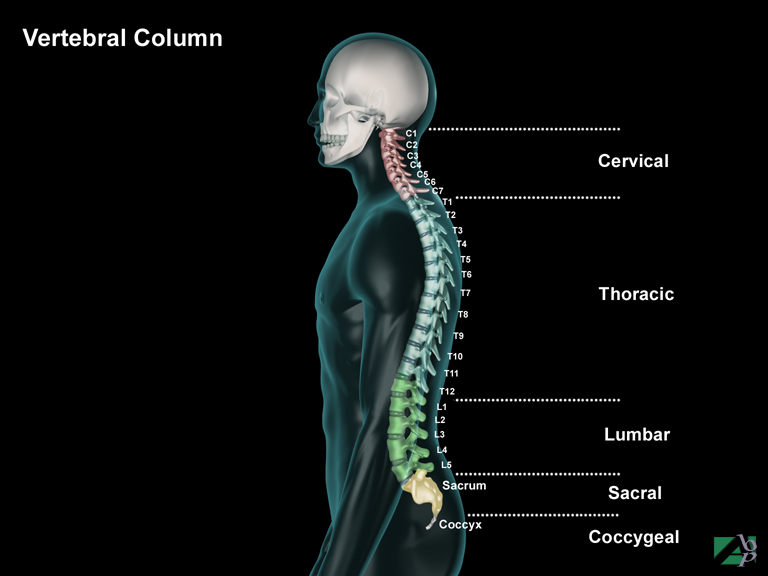
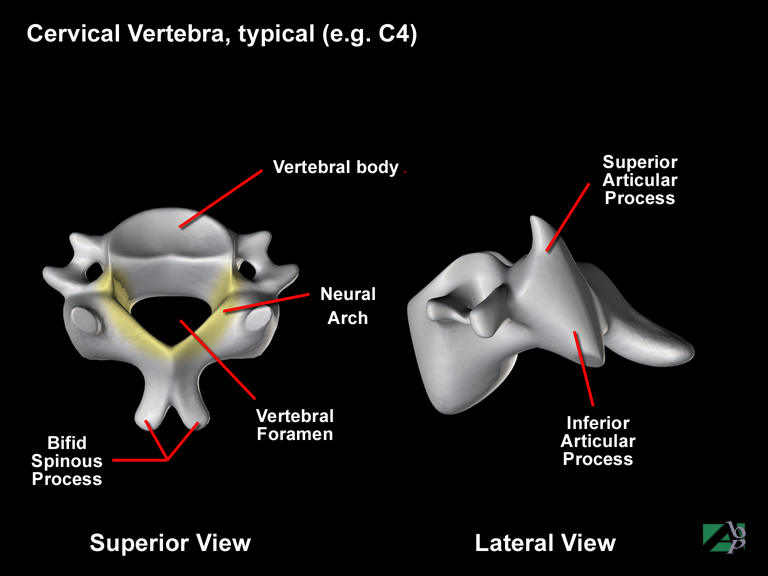
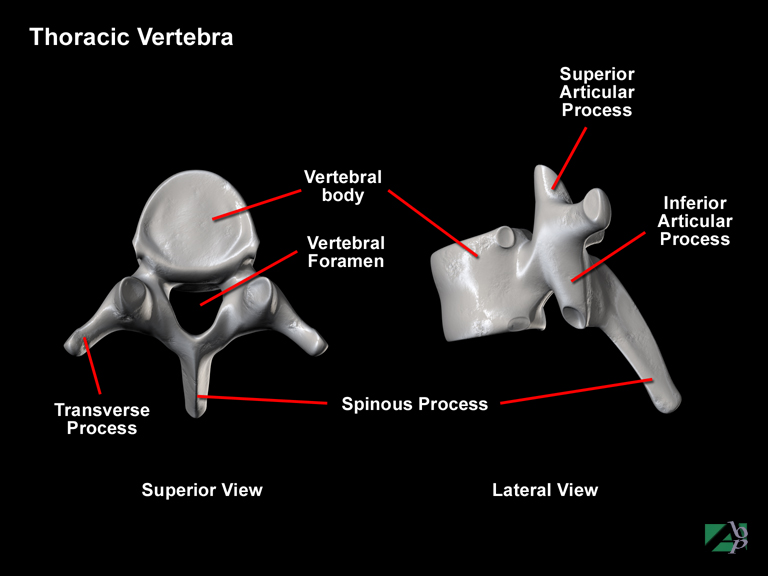
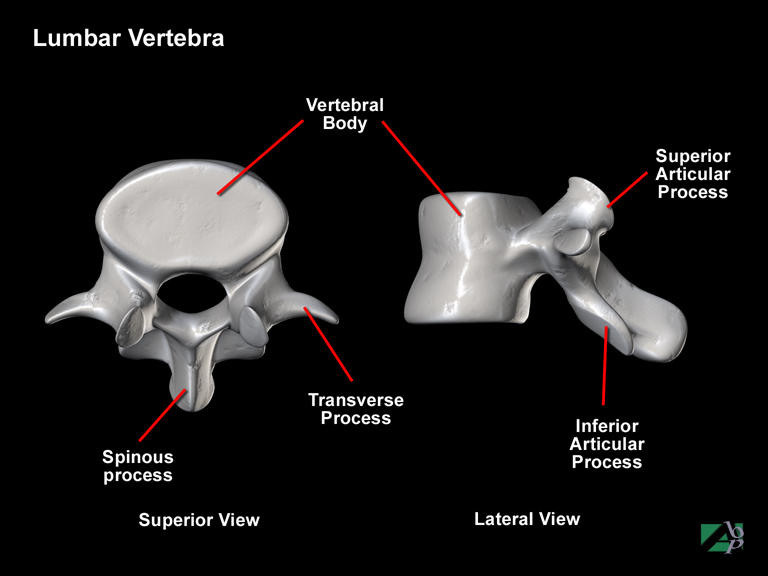
The vertebral column consists of 24 individual vertebrae plus a fused sacrum and a fused coccyx. There are seven cervical vertebrae, twelve thoracic and five lumbar vertebrae. Each vertebra is separated from its adjacent vertebra by a fibrocartilagineus intervertebral disc and is secured to one another by interlocking processes and ligaments. Individual vertebrae are usually referred to alphanumerically, with a letter indicating the spinal region (cervical, thoracic or lumbar), and a number corresponding to the vertebra. While all vertebrae are not identical in structure there are general similarities. A vertebra comprises a body, and a neural arch consisting of pedicles, laminae, foramen and spinous processes. The body is a drum shaped bone, which is in contact with intervertebral discs at each end. The neural arch is a rounded arch like projection from the back part of the body and consists of two supporting pedicles and two arched laminae. A hollow or space formed by the arch and the body is the vertebral foramen through which the spinal cord passes. From each vertebral arch, seven bony processes arise, one spinous process, two transverse processes, two superior articular processes and two inferior articular processes. These processes form the interlocking mechanisms with adjacent vertebra and for ligament attachment. The interlocking mechanisms (the superior articular process and inferior articular process) are known as the pars interarticularis. The cervical vertebrae serve to support the head and allow for head rotation. They are smaller in size than thoracic and lumbar vertebrae. The first cervical vertebra is called the atlas and supports the head. The second cervical vertebra is named the axis, which contains an important projection called the odontoid process. This process permits rotation of the head. The thoracic vertebrae attach to the ribs and form the posterior anchor for the rib cage. They are larger than cervical vertebra and increase in size as they descend. The lumbar vertebrae are the largest of the vertebrae with thick blunt processes for the attachment of strong back muscles and ligaments
Vertebral Column
Refers to the entire vertebral spine, i.e., all the cervical, thoracic, lumbar vertebrae, the sacrum and the coccyx
Vertebral Foramen
The opening in the vertebrae, each of the vertebra have this opening which constitutes the vertebral canal
Vertigo
Dizziness, a feeling of being unsteady or light headed
Vestibular Neuronitis
Vestibular neuronitis is a disorder characterized by bouts of dizziness (vertigo), which may be accompanied by sharp stabbing pains in the ear. It may also be accompanied by nausea and vomiting. Its etiology (cause) is unknown
Villinodular Synovitis
Villinodular or Villous synovitis describes a nipple like projection containing blood vessels on the surface of a synovial membrane, which protrude into the joint. These nipples or villi produce the synovial fluid. This form of synovitis is inflammation of the villi
Visual Acuity
Sharpness of vision
Vitrectomy
Vitrectomy is the surgical removal of vitreous matter from the posterior chamber of the eye. Vitreous matter is known as vitreous humor, which is a fluid like material that fills the interior of the eye behind the lens. A number of vitrectomy procedures are performed, which essentially involve cutting and suctioning of the vitreous and infusion of a saline substitute, which is necessary to ensure intraocular pressure is maintained. Three basic vitrectomy procedures are performed, they are: anterior vitrectomy using scissors or needles, anterior vitrectomy using aspiration and mechanical vitrectomy using mechanical instruments
Volar
Refers to the palm of the hand or the sole of the foot
Vomer
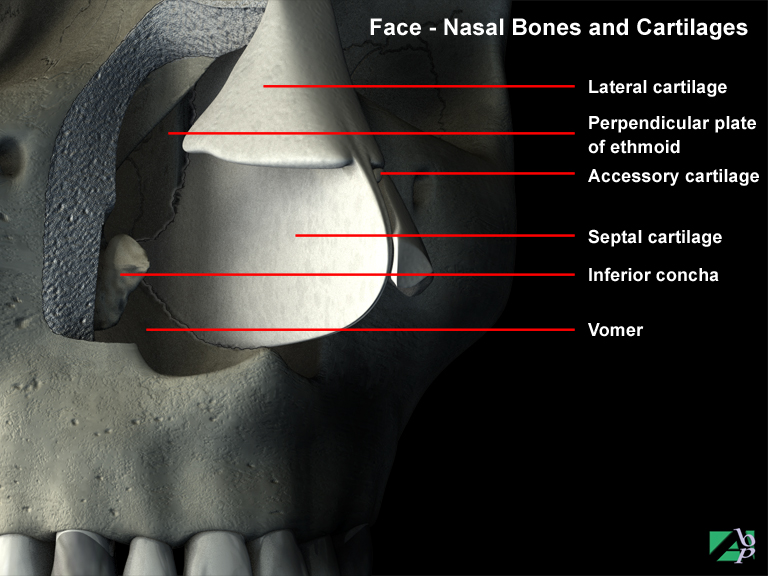
This is a thin plate of bone that forms the lower part of the nasal septum that divides the nose into two cavities and helps support the septal cartilage to complete the septal septum