Kidneys
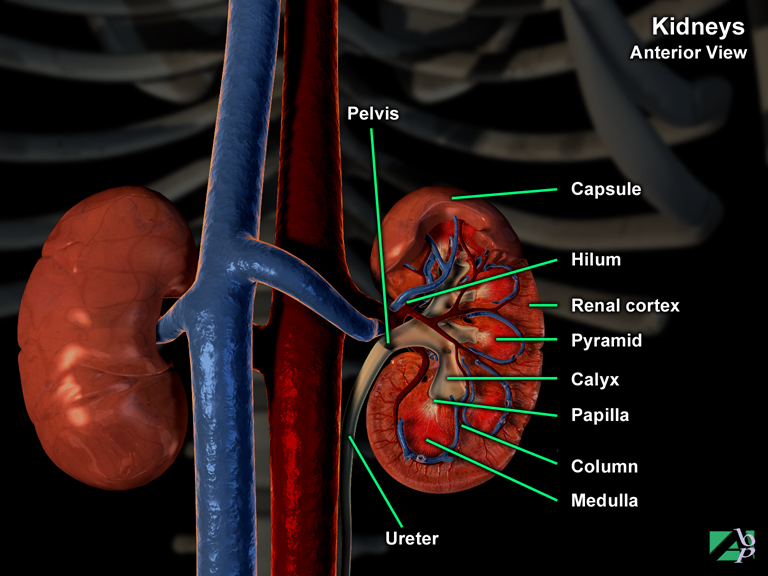
The kidneys are the functional unit of the urinary system, which comprises the kidneys, the paired ureter, the urinary bladder and the urethra. The two bean shaped kidneys lie on each side of the vertebral column at a level from the 12th thoracic vertebra to the 3rd lumbar vertebra. They are described as being retroperitoneal, which means they are outside the peritoneum and therefore not strictly within the abdominal cavity. The right kidney is usually lower then the left because of the position of the liver above. Each kidney consists of three layers. The innermost layer is the renal medulla, the second layer is called the adipose capsule and the outer layer is known as the renal cortex, which is surrounded by a fibrous structure called the renal capsule. The kidneys are anchored to the abdominal wall by the peritoneum. The function of the kidneys is to extract urine from the liquid portion of the blood and the waste materials dissolved in it. Blood is circulated continuously through the kidneys and units within the kidney called nephrons do the filtering. There is estimated to be over one million nephrons within each kidney. A nephron consists of urinary tubules and small blood vessels. Each filtering unit comprises a renal corpuscle (a tuft of blood capillaries) and a long slender tube called a tubercle, which is a collecting duct for the urine. Blood passes through the walls of the renal corpuscle and into the tubercle where the urine is formed and collected by cup shaped structures called calyces and then passed out of the kidneys into the ureter and then on to the urinary bladder