Inner Ear
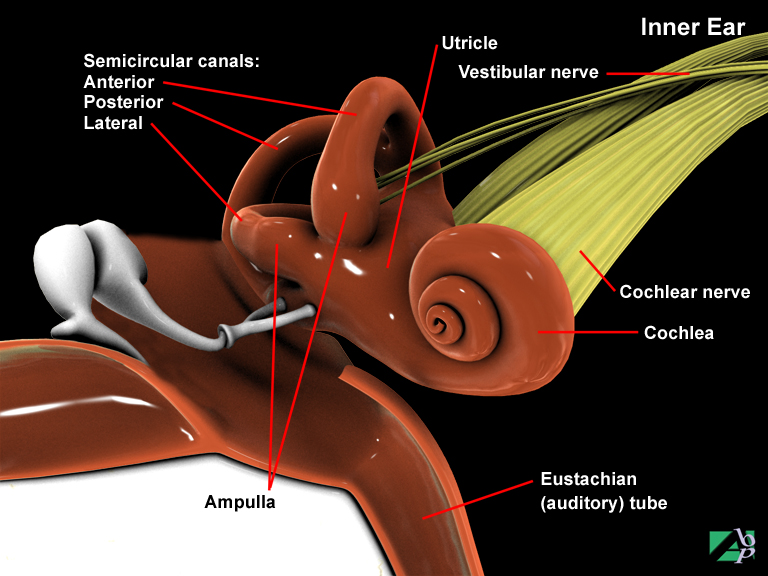
The innermost compartment of the ear is composed of two systems, the membranous and bony labyrinths. The bony labyrinth is formed from part of the temporal bone. It is structurally and functionally divided into three main regions: the cochlea, a snail-shaped tube which houses the organs of Corti (the end organ of hearing that is attached to the acoustic nerve); the semicircular canals, which contain part of the mechanism of balance; and the vestibule, the central region of the bony labyrinth that forms the connection between the semicircular canals and cochlea. The membranous labyrinth is a system of canals that lie within and congruent to the bony labyrinth and are filled with a viscous fluid known as endolymph. The space separating the membranous labyrinth from the walls of the surrounding bony labyrinth is filled with another, distinct fluid called perilymph. The inner ear is also responsible for equilibrium